
ArabnaBook
Connect. Trade. Thrive


Buying your first car in the UAE can feel easy on the surface—until you realize you’re juggling a mechanical asset, a legal transfer, and a long-term financial commitment at the same time. This guide is designed for first-time buyers who want to move calmly and safely through the entire journey: deciding whether you truly need a car, setting a budget, choosing the right type, filtering listings, verifying history, inspecting properly, negotiating without getting played, paying safely, and completing ownership transfer and registration. It also explains the UAE-specific realities that surprise newcomers: GCC-spec vs imports, heat and A/C stress, common used-car tricks, how vehicle testing centers work, and how to avoid the ‘cheap car that becomes the most expensive car’.
If this is your first car purchase in the UAE, the biggest danger isn’t lack of knowledge—it’s rushing. So here’s a simple way to use this guide:
Read Part 1 once to set your budget and your must-haves.
Use Part 2 to choose a buying route (dealer vs private seller) and set your rules.
Use Part 3 as your step-by-step workflow when you start viewing cars.
Use Part 4 on the day of payment + transfer so you don’t miss any legal steps.
Use Part 5 for the first 30 days of ownership to avoid early regrets.
You don’t need to memorize everything. You need a system. A first-time buyer with a system beats an experienced buyer who relies on vibes.

Many newcomers treat car ownership like a rite of passage in the UAE. But owning a car is not automatically ‘freedom’. It can also be a monthly drain. Before you shop, make sure you’re not buying a solution to a problem you don’t have.
Ask yourself these questions honestly:
How many days per week will I drive?
Is my commute mostly metro-accessible?
Will I routinely travel between emirates?
Do I have parking at home and at work?
Am I buying because of real need—or because it feels embarrassing not to own a car?
If your driving is occasional, renting on weekends or using taxis/ride-hailing may cost less than depreciation, insurance, parking, servicing, and surprise repairs. If you drive daily, have family needs, or live far from public transport, a car can be a productivity tool. The key is making the decision with numbers, not social pressure.
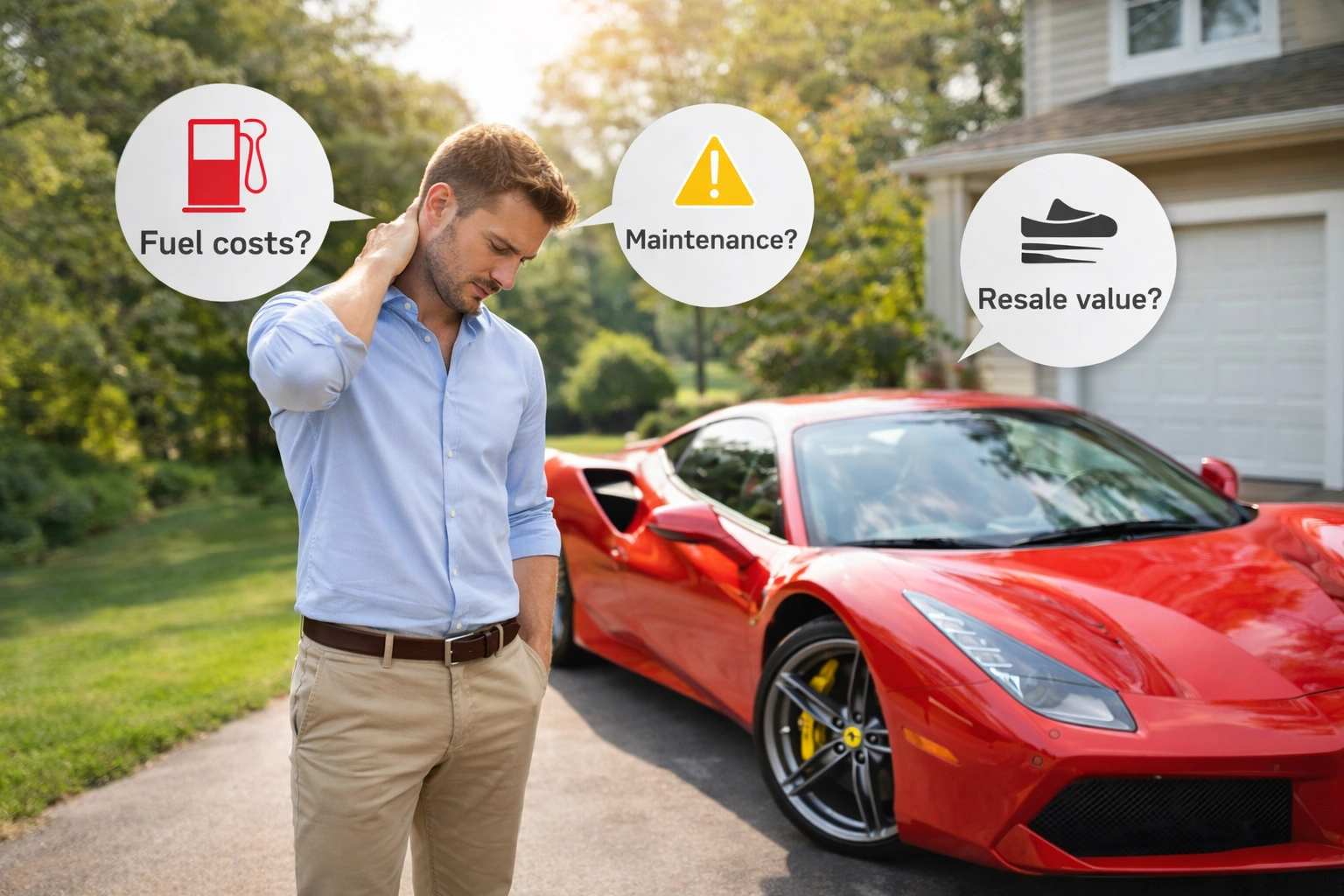
First-time buyers often choose a car that barely fits their purchase budget—then feel trapped when ownership costs start stacking up. A car should not make you financially fragile.
A practical UAE budget framework:
Set your maximum purchase price (cash) or down payment + monthly payment (finance).
Reserve a ‘first-year buffer’ for ownership costs (registration/renewal, tires, battery, minor repairs).
Estimate ongoing monthly costs: fuel, Salik (if you commute through toll gates), parking, and periodic servicing.
Reality check: two cars with the same price can have completely different ownership costs. Some brands are affordable to buy but expensive to keep alive.
In the UAE, how long you plan to stay matters. If you may leave in 12–24 months, depreciation and resale ease should dominate your decision. If you plan to stay longer, reliability and long-term maintenance risk become the priority.
Use this quick rule:
Short-term (≤2 years): prioritize resale value, easy-to-sell models, clean history, and low hassle.
Medium-term (2–4 years): balance value and condition; warranty remaining helps.
Long-term (5+ years): prioritize reliability, parts availability, and ‘boring but dependable’ choices.
The UAE environment is hard on cars: long highway speeds, stop-and-go traffic, dust, and intense heat. Your air-conditioning performance and cooling system health matter more here than in many other countries.
Think in categories, then models:
City-focused: compact sedans, hatchbacks, and small crossovers that are easy to park and cheap to run.
Highway commuters: comfortable sedans/crossovers with stable handling, good A/C, and proven reliability.
Family use: SUVs/MPVs with real rear-seat space, safety features, and manageable running costs.
Work/utility: pickups or vans—buy with maintenance costs in mind.
A common beginner mistake is buying an SUV because it ‘feels safer’ without calculating fuel, tires, brakes, and insurance. Safety comes from crash structure and driver behavior, not just size.
One of the most UAE-specific buying decisions is whether to buy a GCC-spec car or an imported car. GCC-spec typically means the vehicle configuration is intended for Gulf conditions. Imported vehicles may be perfectly fine—or may hide a rough past.
As a first-time buyer, the safe approach is: prefer clean GCC-spec cars unless you can verify the import history properly.
Common import risks to understand:
Severe accident repairs that look ‘clean’ cosmetically but have structural issues.
Flood damage (electrical problems can appear months later).
Odometer inconsistencies.
Parts or specifications that differ from GCC models, making repairs harder or more expensive.
This does not mean every imported car is bad. It means imported cars are higher variance: some are bargains, some are traps. Beginners should avoid high-variance bets.
Your first car does not need to be perfect. It needs to be suitable. The easiest way to avoid impulse buying is to define dealbreakers in advance.
Examples of dealbreakers that keep beginners safe:
No clear ownership history or missing documents.
Seller refuses a professional inspection.
Unresolved loan/mortgage or ownership issues.
Major accident/structural damage (unless you truly understand what you’re buying).
Overheating, weak A/C, gearbox jerks, or warning lights during test drive.

This decision is mostly about risk management. Dealers can be convenient; private sellers can be cheaper. But neither is automatically honest.
A beginner-friendly comparison:
Authorized new-car dealer: safest, most expensive, warranty and clear paperwork. Best if you want minimal hassle.
Large reputable used-car dealer: medium risk; convenience and some protection, but still inspect independently.
Small used-car lot: higher risk; condition varies widely; verify everything.
Private seller: often best value, but you must do the work: history checks, inspection, and legal transfer.
If you’re buying used and you have zero experience, a clean private-sale car with full service history and a professional inspection can be safer than a random ‘polished’ dealer car.
The biggest time-waster for beginners is chasing bad listings. Your goal is to reject 80% of cars before you ever meet the seller.
Filters that save you from trouble:
Avoid listings with vague descriptions, missing VIN/chassis details, or ‘urgent sale’ pressure language.
Prefer listings that show service records, clear ownership, and detailed photos (including interior and engine bay).
Be cautious with prices far below market—cheap usually has a story.
Prefer sellers who answer specific questions clearly (maintenance, accidents, reason for sale).
Before you drive across the city, ask these questions by message or phone:
Is the car GCC-spec or imported? If imported, from where?
How long have you owned it? Are you the registered owner?
Any accidents? Any repainting? Any chassis damage?
Do you have service history/invoices?
Any active warranty? Any service contract?
Any current issues (A/C, overheating, gearbox, electrical)?
Are you okay with a professional pre-purchase inspection at an approved testing center?
Are there any outstanding loans/mortgage on the car?
If the answers feel slippery, defensive, or inconsistent, treat that as information. Beginners lose money when they ignore early warning signs.

You don’t need to be a mechanic to spot many problems. You need a checklist and discipline.
Look for mismatched paint shades between panels (possible repairs).
Check panel gaps: uneven gaps can indicate accident repair.
Inspect headlights/taillights: new on one side only can be suspicious.
Check tires: uneven wear can point to alignment or suspension issues.
Excessive wear on steering wheel, pedals, and seats compared to claimed mileage.
Dashboard warning lights that stay on after starting.
Musty smell (possible water/flood exposure).
Coolant level and color (avoid low coolant or oily-looking coolant).
Oil leaks around engine/gearbox area.
After the car runs, listen for rough idle or irregular sounds.
A test drive is not about falling in love. It’s about collecting evidence.
Test-drive structure (beginner-friendly):
Start the car cold if possible. Notice if it struggles to start.
Drive slowly first: check steering feel, brake response, and unusual noises.
Drive at moderate speed: check gear changes (automatic should be smooth).
If safe, do a short highway run: watch for vibration, pulling, or overheating.
Park and idle for a few minutes with A/C on: A/C should stay cold and stable.
Red flags during test drive:
Gearbox jerks, slipping, delayed shifting.
Steering vibration at certain speeds.
Temperature gauge rising above normal or A/C getting weak while idling.
Knocking sounds over bumps.
Brake shudder or squealing.
For a first-time buyer, a professional inspection is not optional. It is the cost of avoiding expensive regret. In Dubai, RTA-approved inspection/testing is used for registration, renewals, and ownership transfers, and you can also use authorized centers for pre-purchase checks.
RTA’s vehicle inspection service produces a technical inspection certificate (often valid for a limited period), and approved centers like Tasjeel/Shamil are common in Dubai. Always ask the inspection provider what their check includes and what it does not include.
What you want from an inspection report:
Structural/chassis condition (accident indicators).
Leak checks (engine, transmission).
Brake, suspension, steering condition.
Computer diagnostics (error codes).
Cooling and A/C performance indicators (as far as the test covers).
Important: An inspection reduces risk—it doesn’t create certainty. Use it as a negotiating tool and a decision filter.
Never rely on a seller’s story. Your job is to convert the story into proof.
Documents you should expect in a normal, clean transaction:
Vehicle registration card (Mulkiya) for used cars.
Emirates ID of the seller (you need to confirm seller is the registered owner).
Service history or invoices (at least some evidence).
If financed previously: proof of loan clearance / mortgage release before transfer.
If the seller cannot show documents, treat the car as guilty until proven innocent.
Beginners often negotiate emotionally: they try to ‘win’. Smart buyers negotiate logically: they try to reduce risk and pay the fair price.
A simple negotiation system:
Anchor your offer using evidence (inspection issues, worn tires, missing service history).
Separate price from emotion: don’t justify with personal stories.
Make a clean, time-limited offer and be comfortable walking away.
Avoid paying deposits unless you can secure the car with written terms.
Pressure tactics to ignore:
“Many buyers are coming today.”
“I have another offer right now.”
“If you don’t pay a deposit, I’ll sell it immediately.”
“This is Dubai, this is normal.”
The strongest buyer move is silence and willingness to leave. If the car is truly good, it will still be good tomorrow.

A first-time buyer’s biggest financial risk is paying before ownership is legally secure. The safest pattern is to complete payment and transfer in a controlled, documented environment.
Safer approaches:
Meet at an authorized vehicle registration/transfer center and finalize the deal there.
Use a manager’s cheque / bank transfer where traceable, not large cash handovers.
If a deposit is unavoidable, write the terms: amount, conditions for refund, and timeline.
Avoid informal promises like ‘I’ll transfer tomorrow’ after you pay. The transfer moment is when legal control changes. Treat it as the main event, not an afterthought.
Ownership transfer requirements vary by emirate, but the general structure is similar: insurance in the buyer’s name, inspection pass if applicable, documents from both parties, and clearing any blocks such as outstanding loans.
For Dubai, RTA provides a dedicated service to change vehicle ownership, and the process can be done through RTA channels or approved centers. A typical transfer checklist commonly includes the current registration card (Mulkiya), an inspection pass certificate, insurance valid in the buyer’s name, and identification documents for both buyer and seller.
Bring these items to avoid delays:
Original Emirates ID for both buyer and seller.
Seller’s original Mulkiya (registration card).
Buyer’s valid insurance under the buyer’s name (insurance company updates it electronically in the traffic system).
Inspection pass certificate if required for transfer/registration.
Proof of loan clearance/mortgage release if the car was financed.
In Dubai, vehicle inspection can be required for registration, renewal, or ownership transfer, and RTA’s inspection certificate is typically time-limited. If the car fails inspection, you’ll either need repairs and re-test, or you should walk away.
Beginner tip: agree in advance who pays if the car fails inspection. Put it in writing if needed.
If you drive in Dubai, Salik is part of ownership costs. You’ll need a Salik tag and account setup if you don’t already have one. Salik services include purchasing a tag, registering and activating it, adding vehicles, and recharging the account.
Treat Salik like fuel: a small cost per trip that becomes a big cost over months if you ignore it.
Beginner checklist for Salik:
Buy a tag from Salik channels or authorized points.
Register and activate the tag and create your account (or add it to an existing account).
Attach the tag properly to the windshield.
Recharge and keep your balance healthy if your commute crosses toll gates.
The first week is when you confirm you bought a good car—or discover issues you missed.
Do a baseline service (oil, filters) if service history is unclear.
Check tires, brake pads, battery health (UAE heat kills batteries faster).
Monitor coolant level and temperature behavior.
Test A/C performance during hot daytime conditions.
Listen for noises that appear only after longer driving.
Your goal is to keep the car predictable. Predictable cars are cheaper to own and easier to sell.
Follow service intervals and keep invoices.
Fix small issues early (small leaks become big repairs).
Use reputable workshops; cheap work can be expensive later.
Keep the interior clean; UAE buyers judge cars harshly.
Resale is not something you think about when you’re selling. It starts on day one.
Keep service records in one folder.
Avoid modifications that reduce buyer trust.
Repair body damage promptly; small dents hurt perceived care.
If you finance, know your settlement amount and depreciation curve.

Some cars look suspiciously perfect because they were cosmetically restored for sale. Paint, polish, and detailing can hide stories. Always prioritize inspection and documentation over appearance.
Luxury cars can be tempting when used prices look low. But the repair and parts costs don’t become ‘cheap’ just because the resale price dropped. If you can’t comfortably handle a big surprise repair, avoid complex luxury models outside warranty.
Imported cars can be great, but they require verification discipline. Beginners should avoid vague import histories and prioritize clean documentation, inspection results, and transparent sellers.
Never pay a deposit purely because you feel rushed. A deposit is only safe when it is tied to clear terms and a specific action (e.g., passing inspection).
Maximum budget (purchase + first-year buffer) set in writing.
Must-haves and dealbreakers listed.
Ownership horizon decided (short/medium/long-term).
Preferred category selected (sedan/crossover/SUV/etc.).
Rule: no inspection = no deal.
Ask GCC-spec vs imported.
Confirm seller is the registered owner.
Ask for accident history and service records.
Confirm willingness for professional inspection.
Confirm no loans/mortgage or provide clearance proof.
Body: paint mismatch, gaps, headlights, rust, tire wear.
Interior: wear vs mileage, smells, warning lights.
Drive: gearbox smoothness, braking, vibration, temperature, A/C stability.
Decision: if red flags appear, stop negotiating and move on.
Buyer insurance in buyer’s name (electronic update).
Mulkiya present; IDs for both parties.
Inspection pass if required.
Loan/mortgage clearance proof if applicable.
Payment method agreed and traceable; avoid informal ‘later transfer’ promises.
Roads and Transport Authority (RTA) Dubai. (n.d.). Apply for changing a vehicle ownership (service details). https://www.rta.ae/wps/portal/rta/ae/home/rta-services/service-details?serviceId=601
Roads and Transport Authority (RTA) Dubai. (n.d.). Apply for vehicle inspection (service details). https://www.rta.ae/wps/portal/rta/ae/home/rta-services/service-details?serviceId=454
Roads and Transport Authority (RTA) Dubai. (n.d.). Renew and amend vehicle data ownership (service details). https://www.rta.ae/wps/portal/rta/ae/home/rta-services/service-details?serviceId=582
The Official Portal of the UAE Government. (n.d.). Registering vehicles. https://u.ae/en/information-and-services/transportation/registering-vehicles
Salik Company. (2025, February 14). Register and activate a Salik tag. https://www.salik.ae/en/support/salik-services-catalog/register-and-activate-a-salik-tag
Salik Company. (2025, February 14). Purchase a Salik tag. https://www.salik.ae/en/support/salik-services-catalog/purchase-a-salik-tag
ENOC Tasjeel. (n.d.). FAQ: Documents needed for vehicle ownership transfer. https://enoctasjeel.com/faq


