
ArabnaBook
Connect. Trade. Thrive

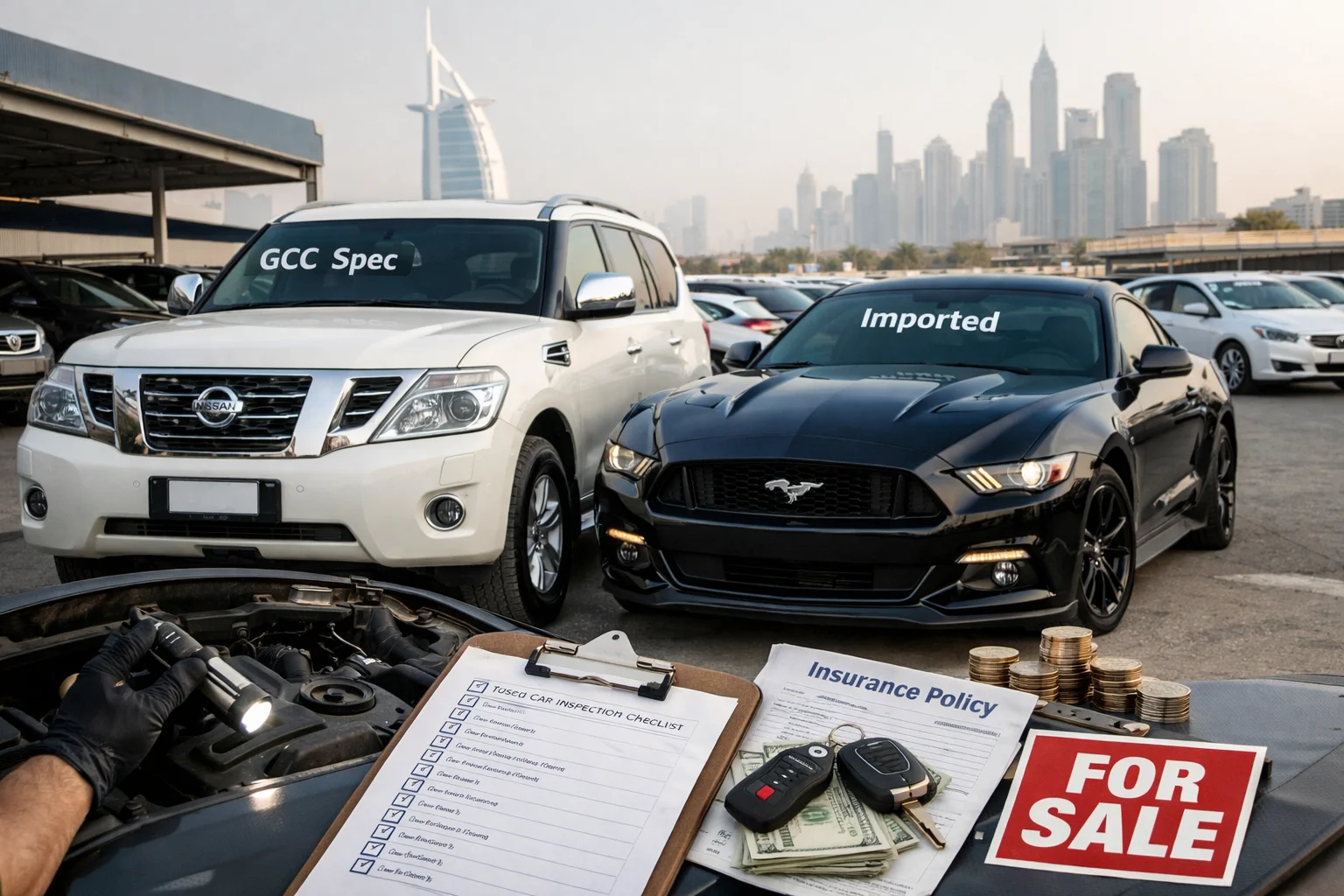
Buying a used car in the UAE often looks simple: compare price, check mileage, take a short test drive, and negotiate. The GCC vs imported decision is where that simplicity breaks. Because you’re not only choosing a car. You’re choosing how much uncertainty you are willing to carry after the purchase—uncertainty about past use, repair quality, insurance terms, resale demand, and long-term reliability in UAE heat.
| Technical Area | GCC Spec (Gulf Market Configuration) | American Spec (US Market Configuration) | What They Are Tested / Designed For | What This Means in Real UAE Use | What a Buyer Should Check |
|---|---|---|---|---|---|
| Homologation Standard | GCC Standardization Organization (GSO) | US FMVSS (Federal Motor Vehicle Safety Standards) | Both follow different regulatory test frameworks | Both are legal standards, but not identical test environments | Not a deciding factor; focus on actual condition |
| Ambient Temperature Design | Typically validated for sustained high ambient temps (often 45–50°C regional expectations) | Validated for US temperature ranges (varies by state, usually lower extremes and highs) | Thermal endurance testing under expected climate | Heat stress margin may differ by model and configuration | Long idle test, AC load test, coolant stability |
| Cooling System Specification | Often larger radiator, higher-flow fans, higher AC condenser capacity (model-dependent) | May use standard cooling package for US market | Engine and cabin cooling under expected climate load | In UAE heat, cooling system margin matters long-term | Check radiator size, fan operation, AC performance at idle |
| AC System Calibration | Tuned for continuous high heat and dust load | Tuned for moderate to hot climates depending on state | Cabin comfort + compressor duty cycle | Some US cars cool well while moving but struggle at idle | Test AC at standstill in midday heat |
| Engine Calibration | Mapped for local fuel quality and high heat tolerance | Mapped for US fuel standards and emissions priorities | Emissions, knock resistance, temperature management | Both run fine here, but long-term heat tolerance margin can differ | Look for overheating or timing pull symptoms |
| Emissions Standard | GCC emissions regulations (often similar to Euro specs) | EPA / CARB emissions (very strict in some states) | Cold start, emissions, catalyst performance | Not a reliability issue; more about original tuning goals | No buyer action needed |
| Crash Safety Testing | Tested to GCC homologation rules | Tested to FMVSS (NHTSA) rules | Both test structural and restraint performance differently | Not comparable by buyer; both are legal frameworks | Focus on whether airbags and sensors work correctly |
| Speedometer / Cluster | km/h primary | mph primary (km/h secondary or digital) | Regulatory display requirements | Visual clue to market origin | Verify cluster is not swapped |
| Electrical System Load Design | Often validated for higher heat and dust environments | Validated for wide US climate range | Connector sealing, heat soak behavior | Heat accelerates aging of wiring and connectors | Check for brittle plastics, random electrical faults |
| Rubber & Plastic Compounds | Often specified for higher UV and heat resistance | Specified for US climate range | Aging tests under expected climate | In UAE, cheap replacements degrade fast | Inspect hoses, seals, bushings |
| Underbody Protection | Sometimes different coatings for sand/heat | Often focused more on salt/corrosion (snow states) | Corrosion vs dust/sand exposure | Not a major issue, but design priorities differ | Visual underbody inspection |
| Software Region Coding | Middle East region | US region | Feature enablement, warnings, units | Some features may behave differently after import | Scan tool check for fault codes and region mismatch |
| Fuel Octane Assumptions | Calibrated for GCC fuel grades | Calibrated for US fuel grades | Knock control and performance targets | Usually not an issue, but affects mapping margins | Check for knock or reduced power behavior |
| Long-Term Thermal Aging | Designed with Gulf climate in mind | Designed with broad but not extreme continuous heat in mind | Heat soak durability testing | UAE heat accelerates aging of marginal components | Inspect cooling, wiring, plastics more carefully |
This guide is written for buyers who want a clean, professional decision process. It avoids assumptions, avoids accusations, and stays grounded in practical checks and official procedures.
GCC spec usually means the vehicle was originally manufactured and sold for Gulf markets and configured accordingly. In practice, buyers often associate GCC cars with stronger suitability for high temperatures and local ownership norms.
But you should treat “GCC spec” as configuration, not a guarantee of anything else.
What GCC spec does not guarantee:
Accident-free history
No repainting or body repair
Perfect mechanical condition
Better maintenance
Higher resale value in every case
The risk many buyers miss: they relax too early. A GCC car can still be a poor purchase if it was neglected, repaired cheaply, or priced incorrectly. The advantage is not “quality.” The advantage is often market familiarity (more buyers want it, more insurers understand it, more workshops have patterns and parts).
In UAE listings, imported commonly means the car was originally sold in another country (often the US, Canada, or Japan) and later brought into the UAE through import channels and then registered after passing required steps.
Imported does not automatically mean bad. It means:
The car’s history may be harder to verify end-to-end
Condition varies widely depending on origin and how it was prepared for resale
Buyers may be more cautious at resale time, which can affect liquidity
A key point for buyers: when the market sees “imported,” it often prices in a “risk discount.” Your job is to determine whether that discount is enough to justify the remaining uncertainty.

A clean way to think about this decision:
GCC spec (typically): higher upfront price, higher certainty, easier resale, simpler insurance conversations
Imported (often): lower upfront price, potentially less certainty, resale may take longer, insurance terms can vary more
Neither is inherently right. The wrong move is buying an imported car with a small discount and treating it like a GCC purchase. If the discount is small, you are absorbing risk without being paid for it.
A practical rule to keep your thinking honest:
If the imported car is only slightly cheaper than a comparable GCC car, you’re likely paying “future costs” in hidden form: time, negotiation, repairs, insurance friction, or resale difficulty.
In Dubai, the RTA vehicle inspection service is described as a roadworthiness check performed at approved centres and linked to registering, renewing, or transferring ownership, with a technical inspection certificate validity period (for that service) stated by RTA.
This matters because many buyers interpret “passed inspection” as “good car.” That’s a category error.
A vehicle inspection is important. It is also limited:
It confirms the car meets required roadworthiness criteria at the time of testing.
It does not act as a full forensic audit of the car’s complete history or the quality of prior repairs.
So treat official inspection as a baseline requirement, not a substitute for a buyer-focused evaluation. For a purchase decision, you still need verification, condition checks, and insurance confirmation.
If you want a process that holds up under pressure, use three layers:
Goal: confirm the vehicle is what it claims to be.
Confirm the VIN/chassis number matches the vehicle and documents.
Check that the seller can provide consistent paperwork (ownership, export/import documentation if applicable).
If buying in Dubai, use RTA’s available digital services where relevant (for example, RTA provides a “Vehicle History Report” service through its channels).
This layer reduces “mismatch” problems and helps you avoid wasting time on listings that cannot be properly documented.
Goal: check recorded incidents or official records that may exist in relevant systems.
Examples of official routes buyers commonly use include:
Abu Dhabi Police provides a public “Vehicle Accidents Inquiry” page that takes a chassis number.
Emirates Vehicle Gate (EVG) provides a traffic accidents management service interface.
Important limitations:
Different emirates can have different data visibility and scope.
Not every incident is guaranteed to appear everywhere.
Absence of a record is not proof of absence of an incident.
So use history tools as helpful signals, not as final proof.
Goal: detect expensive problems that paperwork often doesn’t reveal.
If you do only one thing beyond paperwork, do this layer properly.
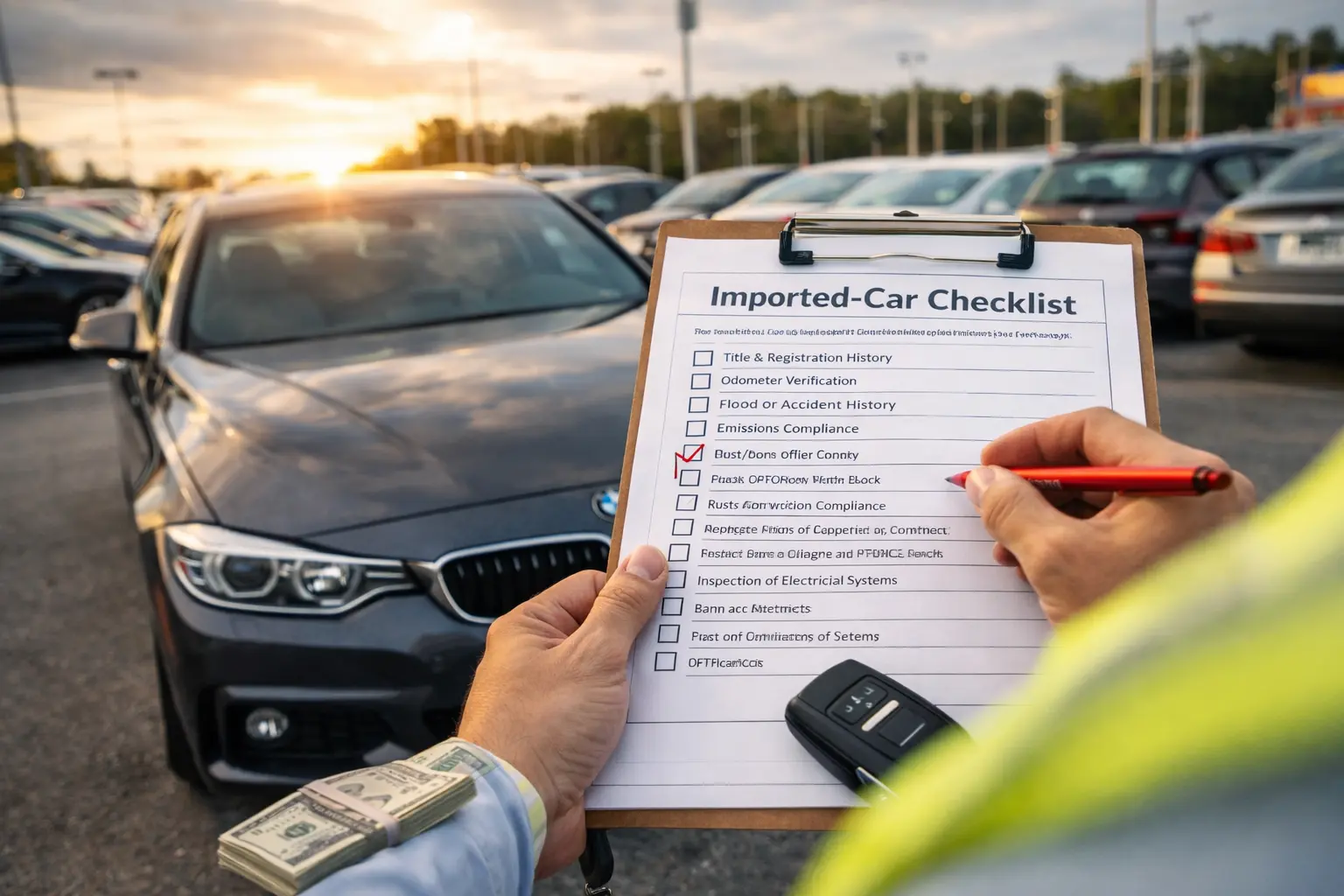
Below is a buyer-focused checklist designed to catch issues that commonly affect long-term ownership costs and resale value. Use it calmly and methodically.
Confirm the VIN appears where expected and matches documents.
Avoid cars where VIN visibility looks altered or inconsistent.
If the seller is uncomfortable with VIN sharing for checks, that is a practical risk signal. You do not need an argument; you need clarity.
Walk around the car slowly and compare:
Door gaps left vs right
Hood and trunk alignment
Headlight and taillight fitment consistency
What you are looking for is not “perfection.” You are looking for inconsistency that suggests prior repair work. Repair work can be acceptable—but inconsistent alignment often predicts negotiation difficulty later and may point to deeper issues.
Repainting can occur for many legitimate reasons. The buyer’s goal is to know what happened, not to judge it.
Check:
Overspray on rubber trims or inside edges
Texture differences across panels
Paint shade mismatch under daylight
Fasteners that look disturbed or replaced
If you find repaint indicators:
Ask for a simple explanation.
Decide whether the price reflects it.
Move on if the story is unclear.
A huge number of “looks fine” cars fail buyers later because of heat load.
Do a heat stress check:
Start the car and let it idle 15–20 minutes.
Turn AC to coldest setting and medium-to-high fan.
Watch temperature stability and listen for fan behaviour.
Check if AC stays consistently cold at idle.
If AC weakens significantly at idle in warm conditions, that’s not a small comfort issue in the UAE. It often becomes a repeated cost and a resale objection later.

Modern cars hide future costs in electronics.
Check:
All warning lights on startup behave normally (they should illuminate briefly and then go off).
Windows, mirrors, parking sensors, cameras, infotainment, steering controls.
No unusual flickering, random error messages, or intermittent function.
An intermittent electronic issue is often worse than a constant one. It consumes time and money because it is harder to diagnose.
Do not rely only on a clean exterior.
Check:
Under-car corrosion patterns (not all rust means disaster, but patterns matter).
Unusual smell in cabin (persistent musty smell is worth attention).
Moisture under mats, trunk lining, spare wheel area.
Seat rail bolts and metal brackets for abnormal oxidation.
You are not trying to “prove” anything. You are trying to avoid unknowns that become multi-visit workshop problems.
Insurance terms can vary by insurer and vehicle details. Buyers get hurt when they assume insurance will be straightforward and only discover constraints after paying a deposit or completing a purchase.
A safe buyer process:
Contact at least two insurers before finalizing.
Provide the VIN and exact car details.
Ask what coverage types are available and what conditions apply.
Even if coverage is available, terms can differ. Knowing this early helps you compare the true cost of ownership—not just the sticker price.
Because processes vary by emirate and situation, buyers should rely on official sources for registration requirements and steps.
Dubai RTA provides service details for vehicle registration-related services and the steps generally involve UAE Pass login, document upload, booking inspection if needed, payment, and plate/delivery selections.
At the federal level, the UAE government portal explains that vehicles can be registered through the traffic authority in each emirate and that services may be offered via centres, websites, or apps.
This matters for buyers because:
A car can be legally registrable yet still be a poor purchase.
Your purchase decision should include friction costs: time, appointments, and potential re-testing.
Many buyers say “resale value” when they really mean two different things:
Resale price: what you might get
Resale liquidity: how easily you can get it (time to sell + size of buyer pool)
In the UAE, GCC spec cars often have broader demand, which can increase liquidity. Imported cars can still sell—but sometimes require:
More buyer education
More negotiation
More patience
If you might sell within 12–24 months, liquidity becomes more important. If you plan to keep the car long-term, the discount may matter more—provided condition checks are solid.
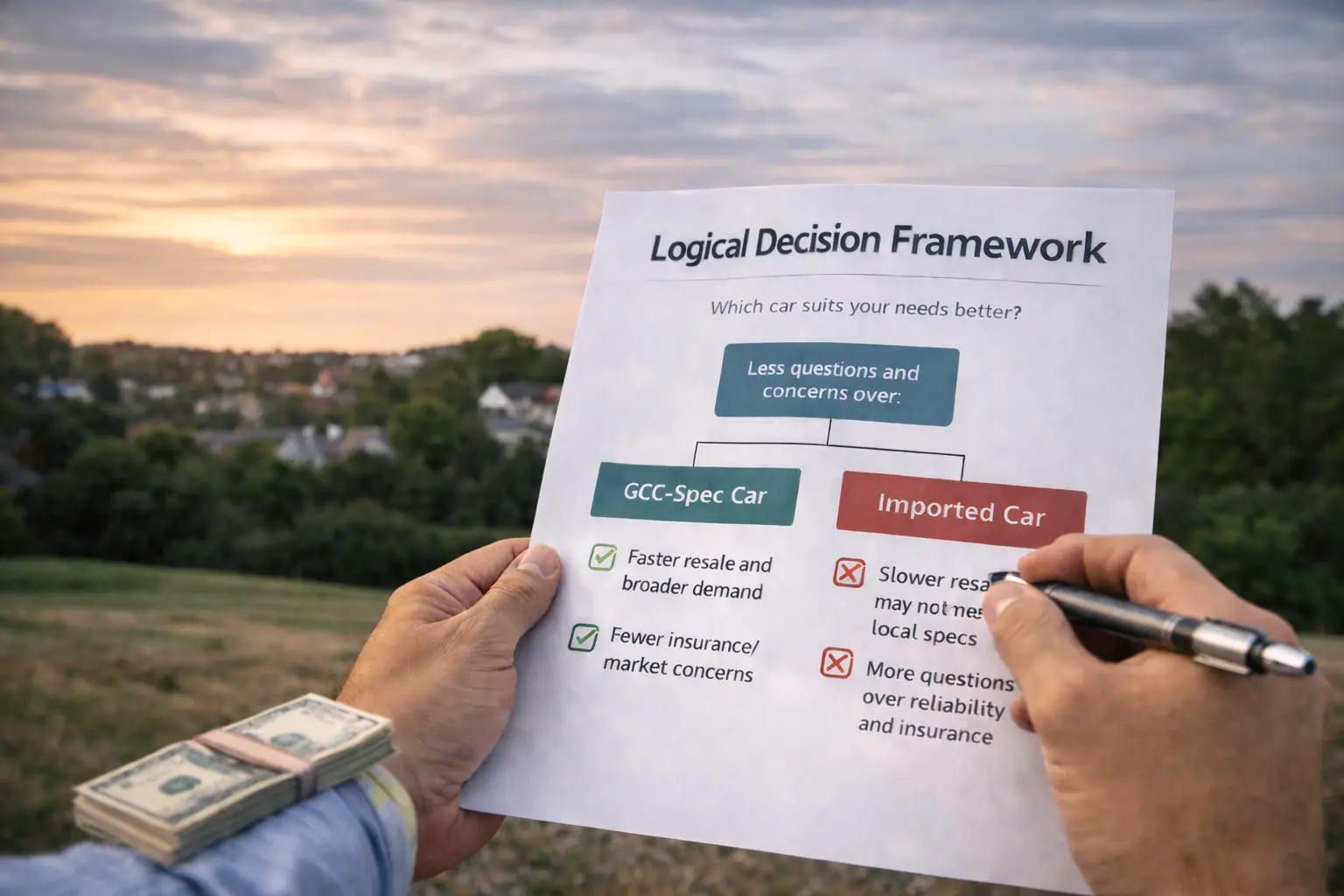
Use this as your final logic gate.
You want faster resale and broader demand
You want fewer insurance/market questions
You prefer predictable ownership patterns in the UAE market
You don’t want to spend time verifying complex history
The price gap is meaningful (you are being paid for risk)
Documentation is clear and consistent
The physical condition checks are strong
You are comfortable with resale taking longer
You’re buying the car you can afford even if a few issues appear later
The goal isn’t to fear imports. The goal is to stop treating “cheap” as “value” before you verify what you’re buying.
If you remember one line, make it this:
A car is not a good deal because it is cheaper. It is a good deal when its price matches its verified condition, ownership costs, and resale reality.
That mindset alone prevents most expensive buyer mistakes in the UAE used car market.
Dubai Roads and Transport Authority. Apply for Vehicle Inspection (service details).
https://www.rta.ae/wps/portal/rta/ae/home/rta-services/service-details?serviceId=454
Dubai Roads and Transport Authority. Vehicle registration-related service details (service details).
https://www.rta.ae/wps/portal/rta/ae/home/rta-services/service-details?serviceId=516
Dubai Roads and Transport Authority. Vehicle History Report (service details).
https://www.rta.ae/wps/portal/rta/ae/home/rta-services/service-details?serviceId=485
Abu Dhabi Police. Vehicle Accidents Inquiry (public service).
https://es.adpolice.gov.ae/TrafficServices/PublicServices/AccidentsInquiry.aspx?Culture=en&mode=update
Emirates Vehicle Gate (EVG). Traffic Accidents Management service page.
https://evg.ae/_layouts/EVG/trafficaccidentsservice.aspx?language=en
UAE Government Portal (u.ae). Registering vehicles (general guidance).
https://u.ae/en/information-and-services/transportation/registering-vehicles


